EX—01Respiratory wearable

Push your limits,not your lungs.

Exera continuously tracks breathing during activity and identifies changes that may signal rising respiratory risk.

Continuous sensing. Personalized baseline. Actionable alerts.
Live · 20 Hz
02The problem

Breathing changes
before symptoms do.

For athletes with asthma, breathing patterns can shift during activity before symptoms feel severe. Exera is designed to identify those changes earlier.

01
Normal breathing
Stable rhythm within personal range.
02
Deviation
Rate and depth begin to drift.
03
Rising risk
Pattern departs from baseline.
04
Symptoms
Tightness, wheeze, shortness of breath.
03Mechanism

Breathing,
measured directly.

Conductive threads at rest (left) and stretched (right)
⟷
At restStretched
Measured resistance · ΔR
457 Ω
ΔR → voltage signal

Exera uses a stretch-sensitive respiratory sensor embedded in the chest band. As the chest expands, the conductive path elongates and electrical resistance changes. That signal is translated into a continuous respiratory waveform.

A
Chest expansion
Inhalation increases thoracic circumference.
B
Sensor stretch
The embedded conductive path elongates.
C
Resistance change
Electrical resistance rises with length.
D
Respiratory waveform
Resistance is translated into a continuous signal.
Output · respiratory waveformt →
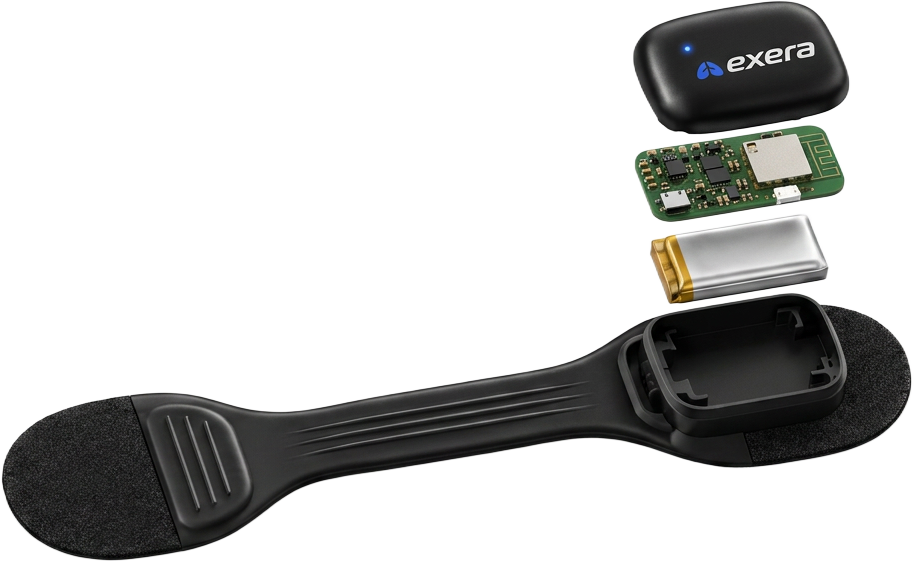
03.5Anatomy

Six parts.
One continuous signal.

Exploded view of the Exera wearable
01
Protective housing
Sealed shell for the electronics module.
02
Bluetooth PCB
Samples the sensor and streams over BLE.
03
Rechargeable battery
Compact cell for continuous sessions.
04
Module cradle
Click-in mount with gold contacts.
05
Stretch sensor
Conductive path that tracks chest expansion.
06
Replaceable adhesive pads
Low-profile chest placement.
04Personalized model

Your baseline matters.

A temporal neural network analyzes short sliding windows of respiratory data and compares them against an individualized baseline to estimate near-term respiratory risk.

01
Respiratory signal
02
Preprocessing
03
Sliding time window
04
Temporal neural network
05
Risk estimate
Feature domains
Respiratory rate trend
weight
Chest-expansion amplitude
weight
Breath-to-breath variability
weight
Deviation from personal baseline
weight
05App experience

Know when
to back off.

Live respiratory waveform01
Current breathing rate02
Personalized comparison03
Rising-risk state04
Alert prompt05
9:41●●●
ExeraLive
Breathing rate
18br/min
Baseline 16–20 · Within range
Amplitude
−3%
Variability
Normal
Risk estimate
Elevated risk
Breathing pattern indicates elevated risk. Consider slowing down or resting.
06Why Exera

Built for the moment
before symptoms escalate.

Traditional inhaler
  • Reactive
  • Used after symptoms begin
Fitness wearable
  • General health signals
  • Not respiratory-pattern specific
Exera
  • Continuous respiratory sensing
  • Personalized baseline
  • Real-time risk estimation
07Use case

Made for movement.

Exera is built for athletes who want more awareness during activity without asthma defining their limits.

Athlete running on a track wearing the Exera chest band
01Low-profile chest placement
02Continuous monitoring during activity
03Real-time mobile feedback
08Technology

Built from signal
to software.

Prototype testing focuses on signal quality, repeatability, motion robustness, and change relative to baseline.

Sensing01
Stretch-based respiratory sensor
Acquisition02
20 Hz continuous sampling
Transmission03
Bluetooth Low Energy transmission
Inference04
Personalized temporal model
09Mission

Start with athletes.
Expand to broader respiratory monitoring.

Exera begins with athletes and active users with asthma, where continuous breathing awareness can matter most during movement. The platform can later extend into broader respiratory monitoring applications.

Athletes with asthma
Active users
Broader respiratory monitoring

Breathe with
more confidence.

Continuous respiratory insight, built for motion.